Business heating
Restaurant and café patio heating that keeps covers open in winter
Radiant heat warms the guest, not the air — which is why it works on a patio that a convection heater cannot hold.
Short answer: For a covered restaurant terrace, plan roughly 80–100 W per m² of seated area; for a terrace open to wind, plan 130–160 W per m². Mount far-infrared heaters 1.8–2.5 m above the floor and aim the radiant face at table height, not at the back wall.
Why radiant heat suits a restaurant patio
A patio is a leaky room. Every time a door opens, or the wind turns, warm air leaves. Convection heating fights that losing battle by trying to hold an air temperature across an open boundary, which is why gas mushroom heaters burn so much fuel to produce a small ring of comfort.
Far-infrared heaters work differently: the element reaches 300–380 °C, the panel emits radiant energy, and that energy is absorbed by people, tables and the floor rather than the air. Guests feel warmth within seconds of sitting down, and the effect survives light air movement because the heat is delivered directionally.
For an operator, the practical consequences are: no warm-up delay before the first sitting, no stratification loss in a tall space, and a heating cost that scales with occupied tables rather than with the volume of outdoor air.
How to size a restaurant terrace
- Measure only the area where guests actually sit. Circulation space and planting do not need coverage.
- Add roughly 30% capacity where one or more sides are open to wind, and treat a fully open roof terrace as an outdoor space, not a covered one.
- Use the published coverage figures as a starting point: our 1.6 kW model is rated for about 20 m², 2.2 kW for 30 m², 3.2 kW for 40 m² and the 4.0 kW model for 50 m² under sheltered conditions.
- Split the load across several smaller units rather than one large unit — coverage is more even, and a single failure does not take out the whole terrace.
- Check the electrical supply early: 3.2 kW units draw 13.9 A at 220–240 V, and the 4.0 kW model is a 380 V unit.
Mounting, aiming and control
Wall-mounted units at 1.8–2.5 m, tilted slightly downward, give the most predictable result along a façade. Ceiling-mounted units suit pergolas and covered courtyards where a wall is not available. In every case the radiant face should point at the occupied zone; a heater aimed at a wall heats the wall.
Zoning matters more than total output. A 40-seat terrace rarely needs full output at 15:00. Group heaters into two or three circuits with separate switches or thermostats, or use the WiFi-controlled 13W series so staff can switch zones from a phone instead of hunting for a breaker.
Sizing guide
| Space | Area | Output | Model | Note |
|---|---|---|---|---|
| Covered terrace, glazed or sheltered | 10 m² | 1.0 kW | 13A / 13B / 13C 1.0 kW | Ideal for a two-table balcony or a small smoking corner. |
| Covered terrace, 2–3 sides sheltered | 20 m² | 1.6–1.8 kW | 22B 1.6 kW or 13 series 1.8 kW | 22B runs hotter (380 °C) for faster perceived warmth. |
| Semi-open terrace with light breeze | 30 m² | 2.2–2.4 kW | 22B 2.2 kW or 13C 2.4 kW | Add a windbreak before adding more power. |
| Open frontage or corner site | 40 m² | 3.2 kW | 22B 3.2 kW or 13C 3.2 kW | Use two units rather than one for even coverage. |
| Large courtyard, engineered layout | 50 m² | 4.0 kW | 13A / 14A 4.0 kW (380 V) | Three-phase supply required; plan circuits with an electrician. |
Coverage figures are the manufacturer ratings for sheltered installations. Wind, ceiling height above 3 m, and single-glazed or open boundaries reduce effective coverage — treat the table as a starting point and confirm the layout with our team before ordering.
Specifications at a glance
Recommended models
22B Series — 1.6 / 2.2 / 3.2 kW
380 °C surface temperature gives the fastest perceived warmth of our wall range, which matters when guests sit down cold and decide within two minutes whether to stay.
13C Series — 1.0 to 3.2 kW
The widest panel in the 13 family, so fewer units cover a long façade; IPX4 splash protection and a 300 °C surface suit permanent terrace installation.
13W Series — WiFi-controlled
Tuya WiFi, LCD remote and four power levels let front-of-house switch zones as the evening cools instead of running everything from opening.
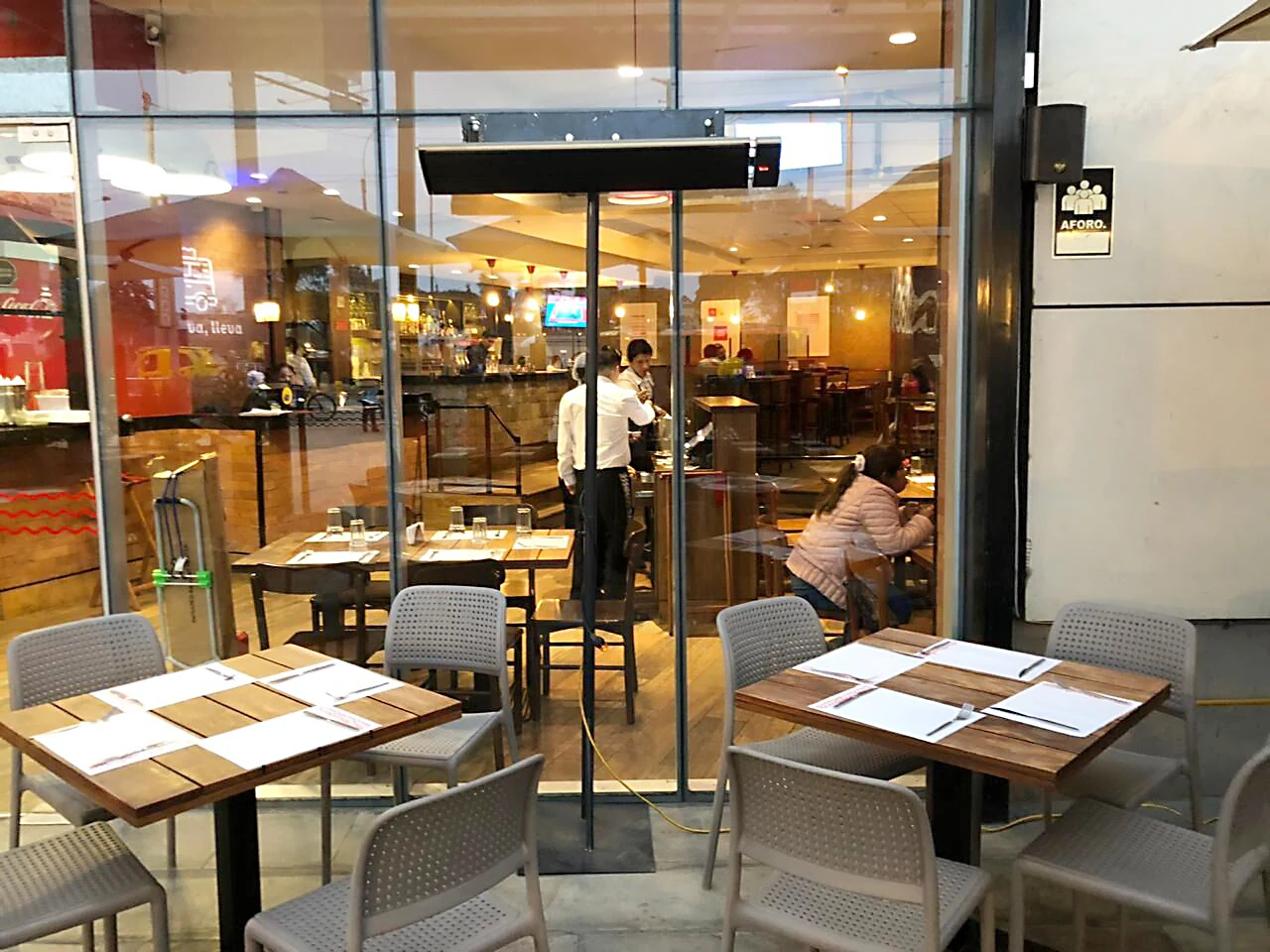
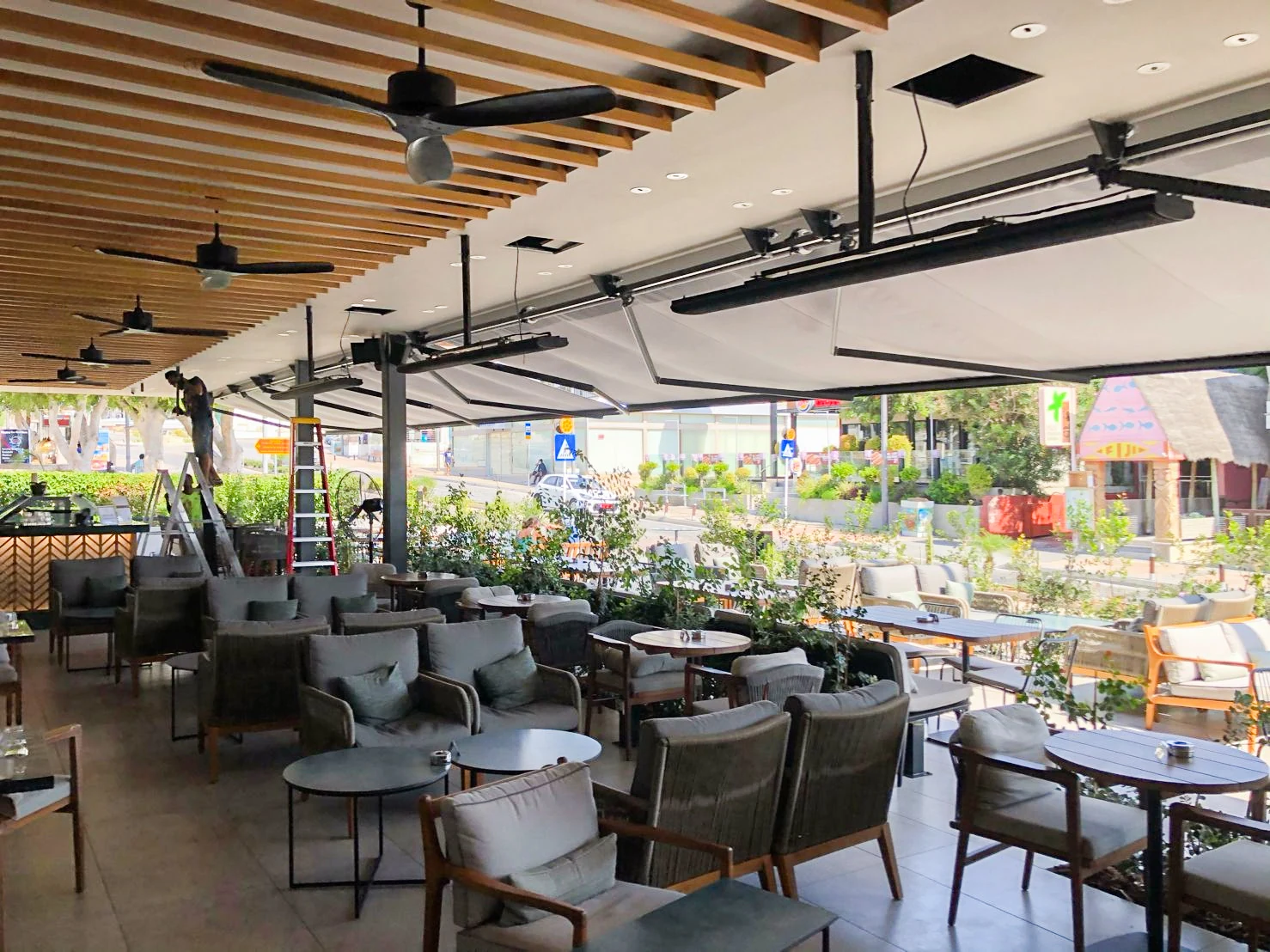
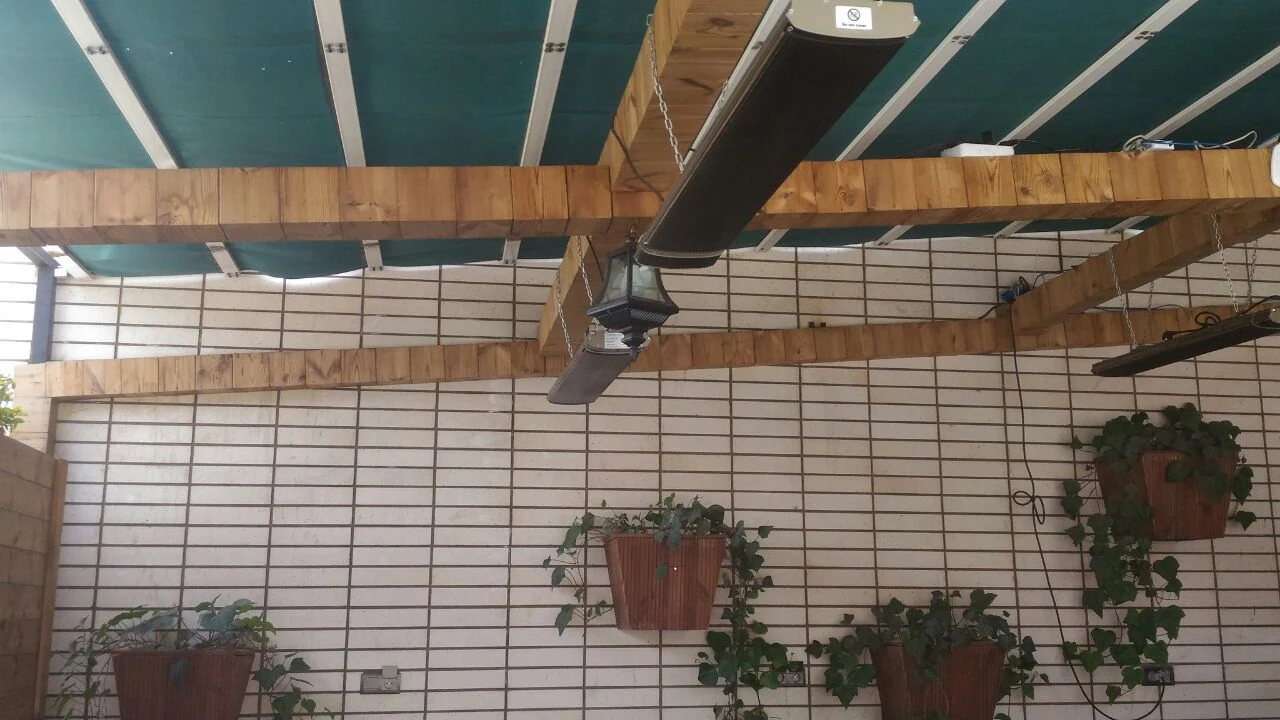
Installed examples
Frequently asked questions
How many infrared heaters do I need for a 40 m² restaurant patio?
Two 3.2 kW units, or three 2.2 kW units, is the usual starting point for a semi-open 40 m² terrace. Spreading the load across two or three units gives more even coverage than a single larger heater, and keeps a failure from closing the terrace.
Do infrared patio heaters work when it is windy?
Radiant heat is directional, so a light breeze is tolerable, but strong wind physically strips the warm layer from skin and clothing. The correct fix is a windbreak — glass screen, planter wall or awning side — before adding more kilowatts. A heater aimed into moving air will always underperform its rating.
At what height should patio heaters be mounted?
We recommend 1.8–2.5 m above floor level. Below 1.8 m the radiant intensity on a standing guest is uncomfortable; above 2.5 m the footprint widens and the perceived warmth at table height drops, especially with a 300 °C panel.
Can the heaters stay outside in the rain?
Our infrared and portable ranges carry IPX4 splash protection, which covers rain falling on an installed unit. IPX4 is splash protection, not a rating for immersion or for pressure washing, and permanent installations should still be on a circuit with RCD protection.
What electrical supply does a restaurant terrace need?
Each 3.2 kW unit draws 13.9 A at 220–240 V, so a typical four-heater terrace needs a dedicated 3-phase distribution rather than a shared ring main. The 4.0 kW model uses a 380 V supply. Send us the layout and we will return a load schedule you can hand to your electrician.
Send us the plan and we will size it
Share the seated area, mounting surfaces and destination market. You get a layout, a circuit load schedule and the certification pack for your market — no obligation.
Request a layout