Business heating
Rooftop bar heating where wind, not temperature, is the real problem
On a roof deck the air is moving. Radiant heat is the only electric option that still works — if the layout respects the wind.
Short answer: Rooftop bars should be planned at 130–160 W per m² and always with a windbreak strategy first: glass screens, planter walls or a pergola with side panels. Mount heaters 1.8–2.5 m above the deck, aim them at seating rather than walkways, and expect 20–30% less effective coverage than the same heater on a sheltered terrace.
Why wattage alone does not solve a rooftop
Every heater has a radiant footprint, and wind erodes it from the edges inward. A 3.2 kW unit that holds 40 m² in still air may hold 25 m² on an exposed roof at 15 km/h. Adding a fourth heater to compensate is expensive and still leaves the upwind tables cold, because the loss is directional.
The sequence that actually works is: reduce air speed at the seating edge, then place heaters on the leeward side of the seating, then add output. Operators who reverse that order usually end up with heaters running at full power and guests still wearing coats.
Layout rules for roof decks
- Define a comfort zone of 20–30 m² around each bar or seating cluster instead of trying to heat the whole deck.
- Mount on the leeward side, facing across the seating toward the prevailing wind, so guests sit in the radiant path rather than behind a heater.
- Keep heaters out of the direct line of open stairwells and lift lobbies, where stack effect creates constant air movement.
- Use two circuits: one for the early-evening core seating, one for the late-night overflow area.
- Check structural fixing and wind loading with the building engineer before specifying brackets; roof decks expose fixings to far higher loads than terraces.
What to specify
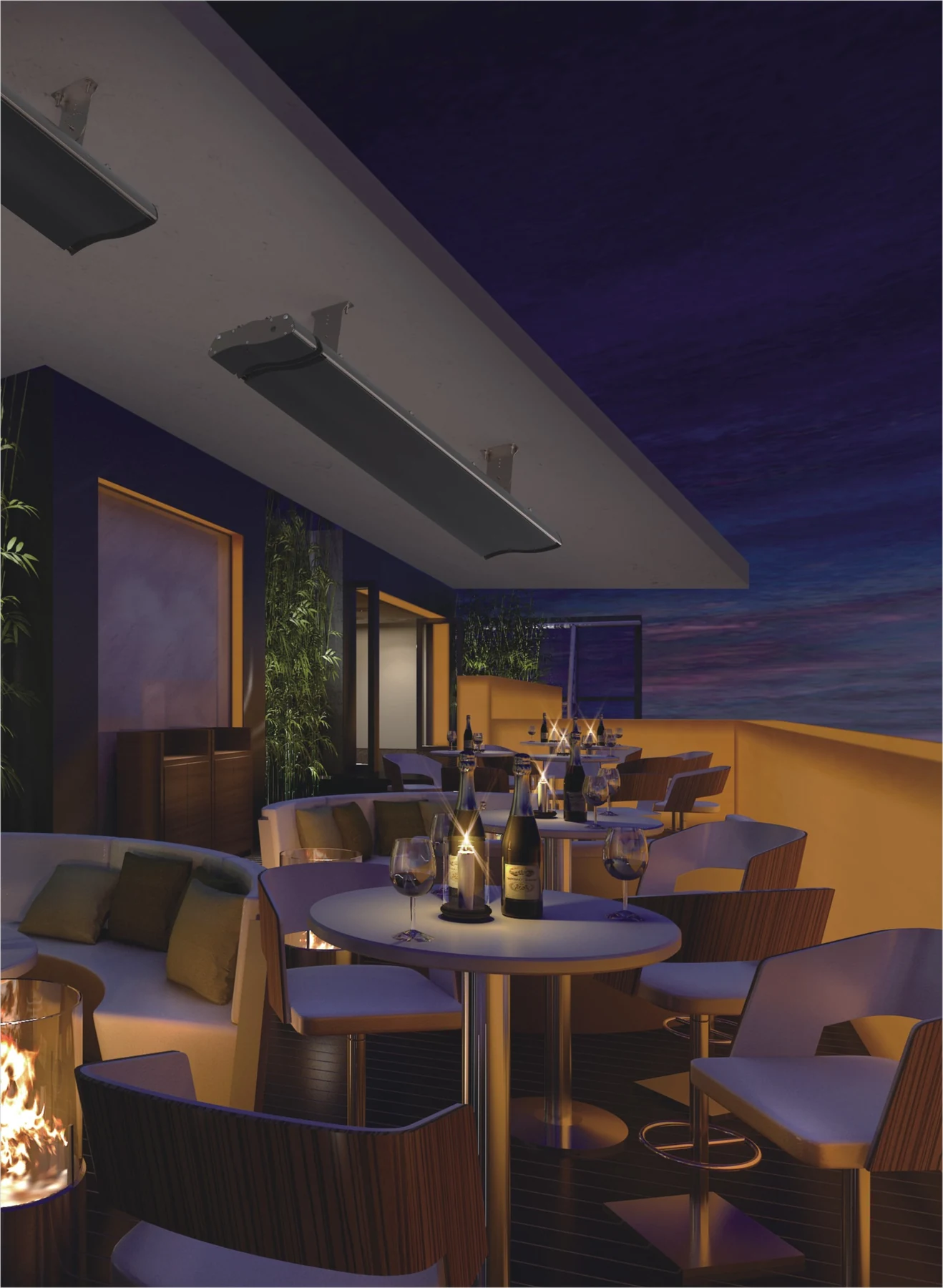
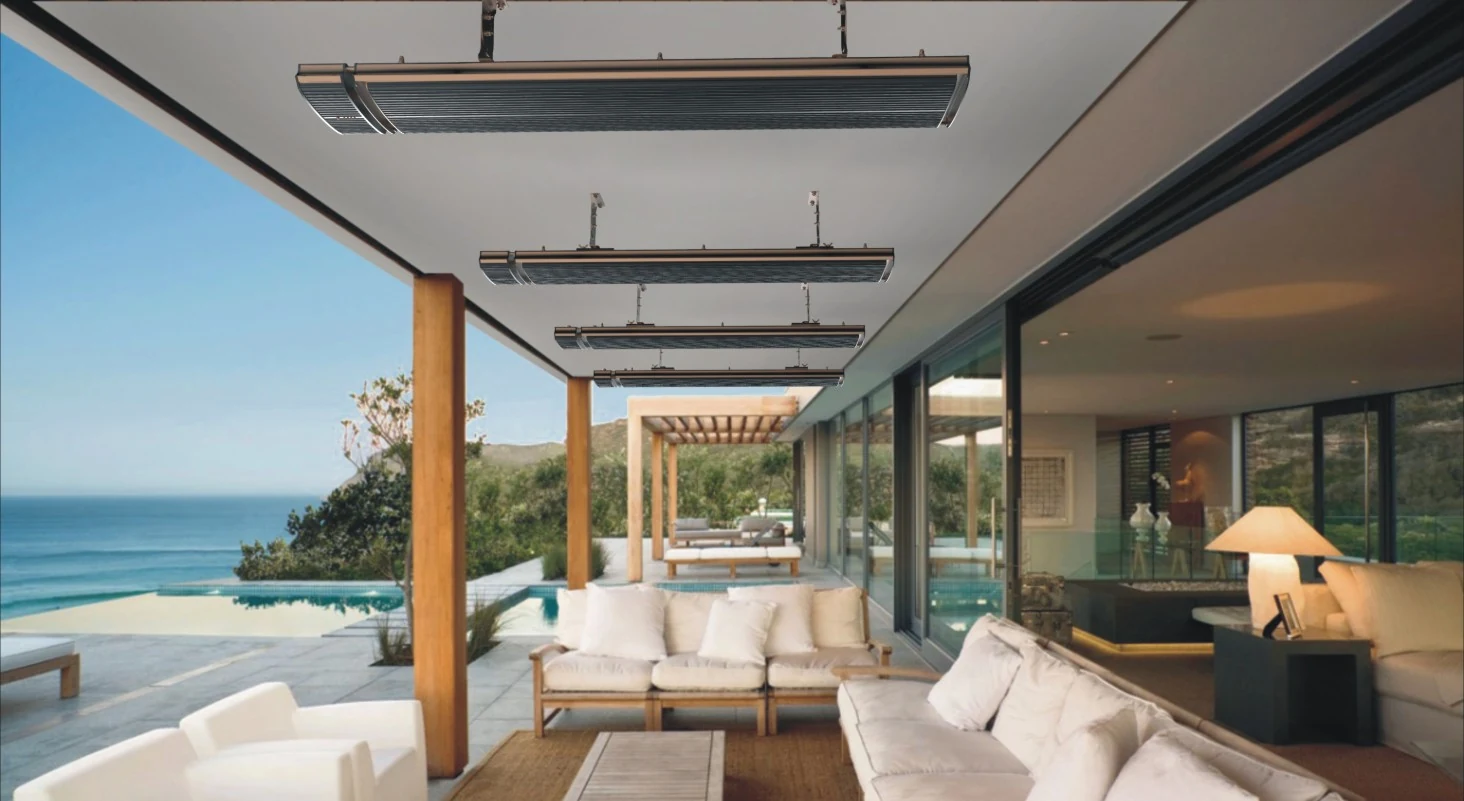
For exposed decks we recommend the 22B series: a 380 °C surface temperature at 1.6–3.2 kW gives a longer effective throw than a 300 °C panel of similar wattage. Wall mounting at 1.8–2.5 m along a parapet, angled down toward seating, is the most predictable arrangement. Where no wall exists, freestanding units with weighted bases are the practical alternative, accepting that they can be moved by staff as the wind shifts.
The 22B is IPX4 rated and available for 220–240 V supply; the 3.2 kW unit draws 13.9 A, so plan a dedicated circuit per pair of heaters rather than daisy-chaining.
Sizing guide
| Space | Area | Output | Model | Note |
|---|---|---|---|---|
| Sheltered roof terrace behind a parapet | 20 m² | 1.6–1.8 kW | 22B 1.6 kW | Parapet acts as a partial windbreak. |
| Semi-exposed deck with glass screens | 30 m² | 2.2 kW | 22B 2.2 kW | Screens on the two windward sides. |
| Open corner deck | 30–40 m² | 3.2 kW | 22B 3.2 kW | Two units, positioned downwind of seating. |
| Bar counter under pergola | 15 m² | 1.6 kW × 2 | 22B 1.6 kW or JHD028-B ceiling | Overhead mounting keeps the counter clear. |
| Large roof event space | 50 m²+ | 4.0 kW | 14A 4.0 kW (380 V) | Engineered layout; windbreaks mandatory. |
Exposed decks lose 20–30% of rated coverage to wind. If the venue cannot add screens or a pergola, plan for the higher end of the watt-per-m² range and accept a smaller comfort zone rather than a larger lukewarm one.
Specifications at a glance
Recommended models
22B Series — highest surface temperature
380 °C at 1.6–3.2 kW produces the longest usable throw in our wall-mounted range, which is what an exposed deck needs most.
13C Series — wide panel, 3.2 kW
A wider radiant face covers a long bar counter with fewer fixing points where wall space is limited.
JHL004-B freestanding patio heater — 3.0 kW
When no wall or beam is available, a freestanding 3.0 kW unit can be repositioned as the wind shifts between seasons.
Installed examples
Frequently asked questions
How do I heat a rooftop bar that is always windy?
Reduce air speed at the seating edge first — glass screens, planter walls, or a pergola with side panels. Then mount heaters on the leeward side facing the seating. Only then add output. On an exposed roof, adding heaters without a windbreak typically raises running cost without fixing the cold tables.
How much coverage does a heater lose in wind?
Assume 20–30% loss on a semi-exposed deck and more at gusty corners. That is why we quote rooftop coverage separately from the sheltered rating: a 3.2 kW unit rated at 40 m² sheltered is realistically a 28–32 m² heater on an open roof.
Can heaters be mounted on a parapet wall?
Yes, provided the fixing is engineered for wind load and the heater faces inward over the seating. Parapet mounting keeps the radiant path above head height and clear of furniture, and the parapet itself becomes part of the windbreak.
Are freestanding heaters or wall heaters better on a roof?
Wall or beam mounting is more predictable and harder to knock over. Freestanding units win where there is no structure to fix to, or where the seating layout changes seasonally — at the cost of floor space and stability in gusts.
What power supply does a rooftop installation need?
Each 22B 3.2 kW unit draws 13.9 A at 220–240 V. For a deck with six units, plan a three-phase distribution with per-zone RCD protection; rooftop circuits also need weatherproof enclosures and cable routing rated for UV exposure.
Send us the plan and we will size it
Share the seated area, mounting surfaces and destination market. You get a layout, a circuit load schedule and the certification pack for your market — no obligation.
Request a layout